
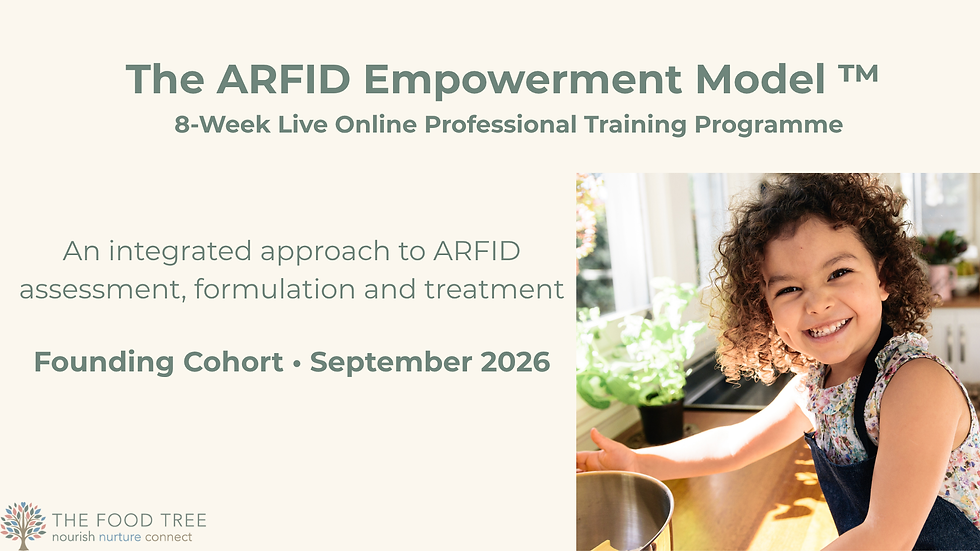
The ARFID Empowerment Model™ Professional Training
Wed, 14 Oct
|Online
An Integrated Manualised Approach to the Assessment and Treatment of ARFID and Selective or Restricted Eating. An Integrated Approach to the Assessment and Treatment of ARFID and Selective or Restricted Eating
Time & location
14 Oct 2026, 12:00 pm – 2:00 pm
Online
Event details
ARFID is complex. Supporting it requires more than one lens.
Sensory differences, anxiety, neurodivergence, nutritional risk, medical factors, feeding experiences, family dynamics and the wider environment can all shape a person’s relationship with food.
These areas are often assessed and treated separately. The ARFID Empowerment Model™ brings them together.
The programme provides an integrated, manualised framework for assessment, formulation and treatment.
It helps clinicians understand what may be contributing to and maintaining a person’s eating difficulties. It also supports them to identify what needs attention first, and where support, accommodation or capacity building may be most helpful.
Rather than applying the same intervention to every person, the model supports individualised care. The focus is on understanding what is happening for that person and what meaningful progress looks like for them. Neurodiversity-affirming practice, trauma-informed care and responsive feeding principles are woven throughout assessment and intervention.
This Programme Will Help You:
Develop a comprehensive and individualised understanding of ARFID presentations.
Bring nutritional, medical, psychological, sensory, neurodevelopmental, relational and environmental information together into a meaningful formulation.
Recognise nutritional, medical and psychosocial risk and identify appropriate referral pathways.
Understand how neurodivergence, sensory processing, interoception, executive functioning, masking and burnout can affect eating.
Apply responsive feeding and trauma-informed principles within ARFID care.
Recognise the impact of pressure, coercion, shame and previous feeding experiences.
Support nourishment while balancing nutritional, psychological, sensory and relational needs.
Identify when accommodations may reduce barriers, support nourishment and improve quality of life.
Support caregivers and wider systems without blame.
Develop collaborative goals based on what matters to the individual.
Use food exploration and exposure in ways that remain responsive, collaborative and consent-based.
Recognise when exposure may be useful — and when accommodation or another form of support may be more appropriate.
Measure meaningful progress beyond food variety alone.
Apply a structured clinical framework while continuing to individualise care.
The ARFID Empowerment Model™
The model is organised around five interconnected phases:
Phase 1: Assessment, Formulation and Risk- Developing a whole-person understanding of the presentation and identifying immediate priorities.
Phase 2: Felt Safety, Regulation and Relationships- Reducing pressure, understanding experiences around food and creating the conditions in which change may become possible.
Phase 3: Nutrition and Nourishment- Supporting nutritional adequacy, growth and physical safety.
Phase 4: Acceptance, Mindset and Capacity Building- Supporting autonomy, confidence and meaningful change through collaborative, individually matched approaches.
Phase 5: Accommodations, Integration and Life- Supporting long-term accommodations, self-advocacy and meaningful participation in everyday life.
The overarching aim is to support individuals and families to move towards:
Safety. Nourishment. Growth. Acceptance. Autonomy. Meaningful participation in life.

Practical Tools You Can Use in Clinical Practice
The ARFID Empowerment Model™ is designed to be applied in practice.
Alongside the live teaching, participants will receive a comprehensive printable manual and access to an online resource hub containing clinical tools, worksheets and templates.
The tools are designed to provide structure while allowing care to remain individualised.
Who Is This Programme For?
This programme is primarily designed for health professionals supporting children, adolescents and young adults with ARFID and selective or restricted eating.
This may include:
Dietitians
Psychologists
Occupational Therapists
Speech-Language Therapists
Medical Professionals
Nurses
Psychotherapists
Social Workers
Counsellors
Eating Disorder and Feeding Clinicians
The programme is dietitian-led and designed for multidisciplinary practice.
Many of the principles and tools can also be adapted for adult practice.
Course Delivery
8 Weekly Live Online Sessions. The founding cohort will commence in the week of 14 September 2026 and run for eight weeks.
All Sessions Recorded. All live sessions will be recorded, with 12 months’ access to the recordings.
Comprehensive Manual and Resource Hub. Participants will receive a printable course manual and 12 months’ access to the online resource hub, including clinical tools, worksheets, templates and additional course resources.
Interactive and Applied. Sessions will include clinical examples, case formulation, discussion and opportunities to apply the model in practice.
Programme Investment
Early Bird- NZD $1,295
Standard Registration- NZD $1,495
Payment Plan- 4 × NZD $395
A limited number of reduced-fee places will be considered individually. Please get in touch if cost would otherwise prevent you from participating.
Join the Founding Cohort
The first live cohort of The ARFID Empowerment Model™ begins in the week of 14 September 2026.
Places will be limited to support interaction, discussion and clinical application.

Food Tree events are hosted by
Rachael Wilson
Paediatric and Eating Disorder Dietitian &
Family Feeding Specialist
Rachael is a paediatric and eating disorder dietitian and family feeding specialist with extensive experience and expertise. She is one of only 7 people worldwide selected by the Ellyn Satter Institute in the USA to become an affiliate child feeding specialist, trained in responsive feeding therapy.
With a strong background in mindfulness and intuitive eating, Rachael is also trained in mindful eating through The Centre for Mindful Eating. Additionally, she has specialised training in CBT for eating disorders and body image, bringing a compassionate, evidence-based approach to her work with families.
Don't miss out on the training!
Here's what other parents are saying about The Food Tree approach
I’m a huge fan of The Food Tree and their approach to body image and fostering a positive relationship with food. They’re informative, knowledgeable, helpful, and gentle. I’ve attended several of their workshops, and each time I leave with new tools to create a positive environment for my children around body image and self-acceptance.
Gemma Vergo
I learned so much from the workshop! Thank you. I feel much more relaxed about how I approach body image discussions with my kids, and they seem more confident in their own skin.
Isabelle Vincent
"Brilliant talk. So interesting and all of what was said makes perfect sense. Highly recommend"
"Evidence-based, practical and empathetic advice that has helped our family relax at meal times, highly recommend!"
